
Walking Together: Reflections from the Walk for Truth
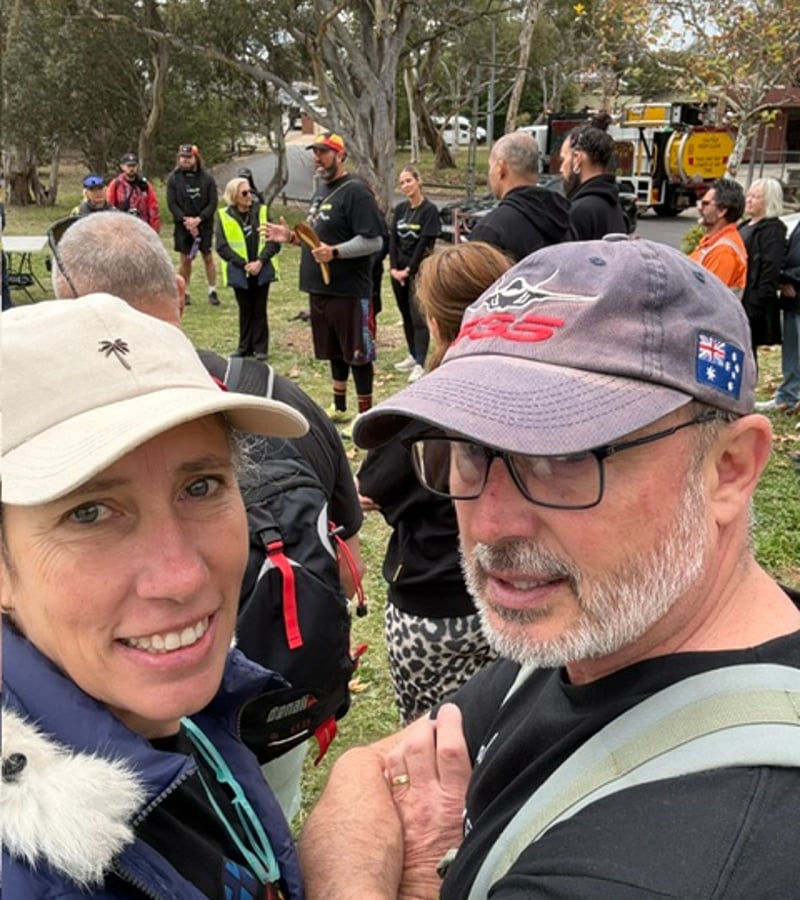
A group of Aussies mustered in a suburban park on a wet and dreary Canberra morning to support Yoorrook Commissioner Travis Lovett's National Walk for Truth.
Despite damp conditions, there was a camaraderie of shared support and light hearted banter. After a short welcome by local elders we set off along the waterway towards the Australian National University (ANU) in the centre of the city. There was a fluidity to the group. A hierarchy was not evident and the group's shape morphed and changed as we came to road crossings and bridge access. I found myself conversing with a large number of people. Everyone walking had a common goal to support truth telling in Australia. The walkers were from far and wide and the conversations were deeper and richer than I expect upon meeting someone for the first time.
From the path to the room
There was a crowd gathered as we approached ANU and a formal welcome by the local First Nations' peoples. After a traditional smoking ceremony we moved together into a large function room. Food was provided and microphones set up for speeches for which I did not stay. A level of discomfort had escalated enormously in me. I was reacting to what seemed to be a compulsion for people to work the room in a networking fashion. I felt I was being watched when conversing with a lovely First Nations' fella.
On reflection back to my enjoyment of the walking I was transported to how Dr Mishel McMahon (NIODA First Nations' Lead) had us walking together for many of the 'I am the Land' sessions at the NIODA Group Relations Conference in 2025. I wonder if walking together at team and group events in organisations could be productive of richer and deeper connections, conversations and understanding.
Side by side, not face to face
Sitting with that question afterwards, I keep returning to the moment the walk ended and the room began. There is no head of the table on a footpath; nobody chairs a walk. Walking conversations happen side by side rather than face to face, eyes on the path ahead, and pauses are absorbed by footsteps. It is possible to say something tentative and let it sit for twenty metres. In this way walking may be a form of reflective practice in its own right, the rhythm of footsteps making room for thoughts to surface that a meeting agenda never would. Most organisational encounters ask us to face each other and produce something: an opinion, a decision, an impression. The walking gave us a shared task that required only that we keep going in the same direction — a rare kind of togetherness.
A modest invitation
There is also something fitting about supporting truth telling by walking. Truth telling is not a single event but a journey undertaken together, over ground that is not always comfortable, in weather that will not always cooperate. If walking can hold something as weighty as truth telling, it can surely hold the conversations our organisations find difficult. So perhaps the invitation is a modest one: next time your large team or group gathers, rather than sitting down to discuss, try walking it out together first.
Related insights

Have you been reading organisations all your working life?
Ever wonder why formal plans rarely match workplace reality? Discover how reading organisations and systems psychodynamics turn curiosity into disciplined leadership
Slow Down to Lead: The Reflective Edge in Leadership and Management
Most leaders know something important is being lost in the pace of modern work. The capacity to think clearly, read the room, and lead with genuine presence gets crowded out by meetings, deliverables, and the pressure to always appear in control. Slow Down to Lead explores the reflective edge in leadership — what it means to pause without stopping, why emotion is data not distraction, and how developing a reflective practice changes not just how you lead, but how you see.
This course finds people. Perhaps it has found you.
On what it means to study the experience of work, and why that matters more than ever.